The ERC project Regionalizing Infrastructures in Chinese History (RegInfra) and KU Leuven Early Modern History Research Group are organizing a presentation and discussion with Prof. Jeffrey Tharsen (The University of Chicago). The talk, titled Building Agentic AI Systems for the Humanities, is taking place on Monday, September 21, from 2:00 to 4:00 PM at KU Leuven.
For online participation, please contact: [email protected].
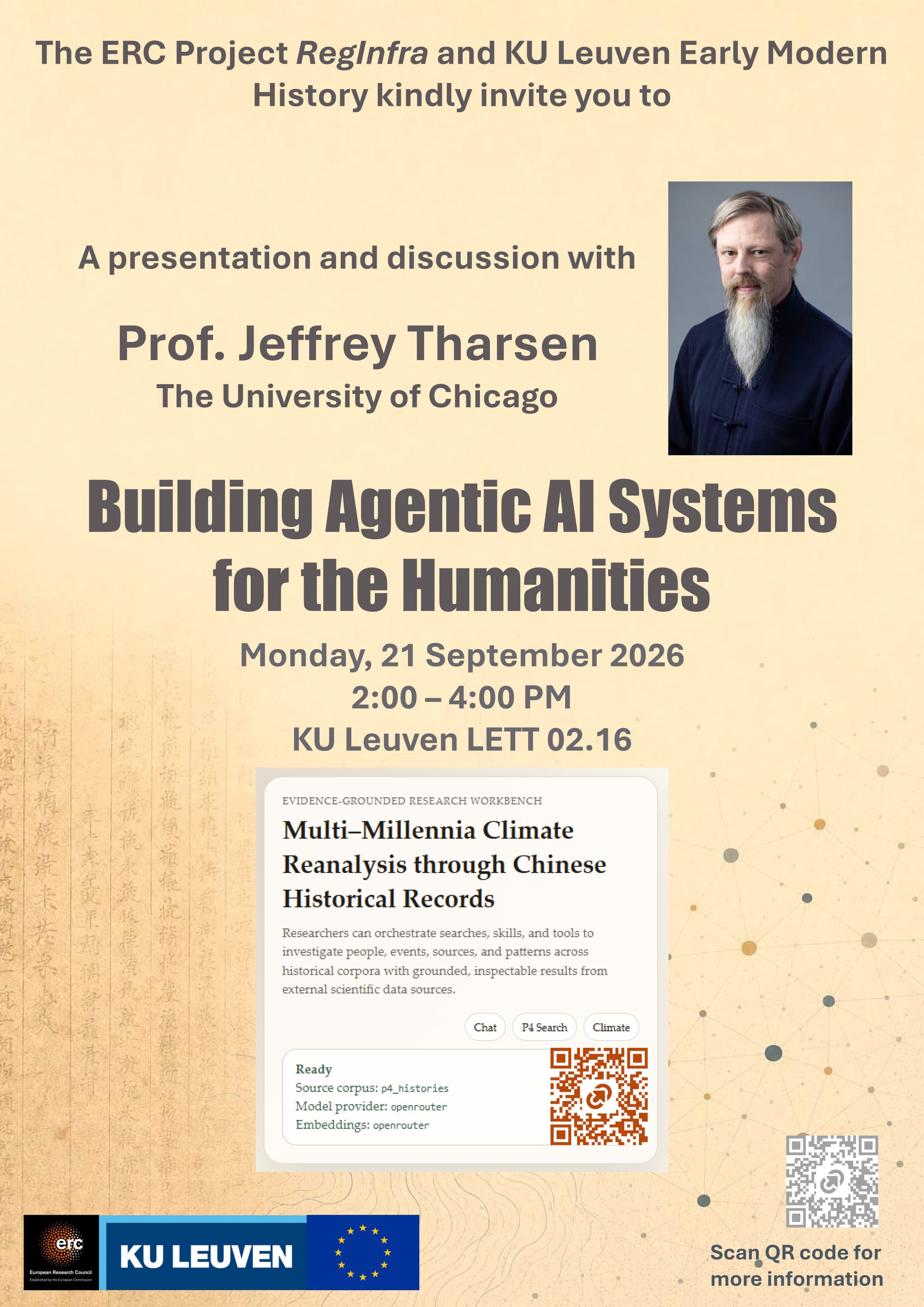
About the talk: At the University of Chicago, we have recently been developing a prototype for an open-source, modular, scalable, extensible and reusable Agentic AI system that combines modern text analytical models with scientific data sources: the MMCRCHR, or “Multi–Millennia Climate Reanalysis through Chinese Historical Records”. In response to a user’s query, it provides both a generated summary of the results plus all relevant underlying prima facie evidence and sources used to produce that summary back to the user: citations from textual sources plus climate science datasets returned from scientific archives. This system was designed with human oversight built into every step in the pipeline in an attempt to identify and counter the relatively high error rates produced by current transformer-based models (“hallucinations”). Our current backend is an LLM fine-tuned on the 40 million characters in the Chinese Official Histories 正史 (24 compendia dating from 90 BCE to 1912 CE, with each passage/chunk dated in preprocessing) and we are in the process of building a multilingual corpus of hundreds of modern and premodern secondary sources on climate change and its effects to serve as our secondary large textual data source. As the system is inherently modular and scalable, we’re working to expand its scope to include data retrieval from dozens of API-based data sources (callable on demand as agentic “skills”); in time, we hope this will become a method by which future scholars can realize the old dream of Linked Open Data: the holdings of all the world’s libraries and data repositories retrievable on demand in the service of developing new avenues for large-scale research, new ideas, and new discoveries.
Link to the MMCRCHR [Multi–Millennia Climate Reanalysis through Chinese Historical Records] system: https://marat.uchicago.edu/ai-pillar-climate
Jeffrey Tharsen holds dual appointments as the University of Chicago’s Associate Director of Technology and Lecturer in the Division of the Arts & Humanities and in the College, serving as primary university-wide technical domain expert for digital and computational approaches to humanistic inquiry.
Jeffrey is known best for his work developing advanced computational research methods for the humanities: as a computer scientist, hyperpolyglot, philologist and and linguist, he has developed new methods for research in a number of modern and premodern languages, with a primary focus on Chinese literature, phonology, paleography, lexicography and historiography.
Jeffrey regularly teaches advanced courses in artificial intelligence and deep learning, LLM architectures, data science, natural language processing and natural language understanding.
His first monograph, Chinese Euphonics, was published in early 2025 by DeGruyter.